
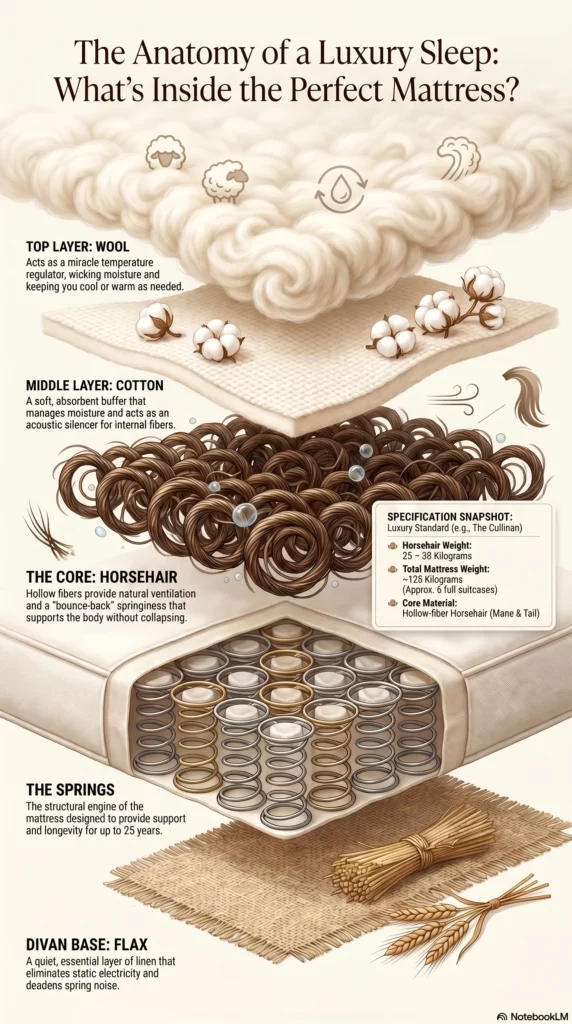
The springs in a luxury mattress will last 25 years without complaint. What determines how the bed actually feels, and how long it keeps feeling that way, is everything wrapped around those springs. Horsehair, wool, cotton, cashmere: these are the materials that regulate your temperature, wick away moisture, and give a well-made bed its characteristic weightless quality. This article explains what each filling does, why the order they are layered in matters, and why synthetics cannot do the same job no matter how they are marketed.
Why the Fillings in Your Mattress Matter More Than the Spring Count
Quick Answer: The springs determine support and longevity. The fillings determine how the bed breathes, how it feels, and whether you sleep cool or overheated. Most sleep problems are temperature problems, and most temperature problems come down to what is in the mattress.
The Sandwich Nobody Tells You About
‘Making a mattress is like making a sandwich,’ Brent says. ‘The core is your spring, and then it is the layers, and how you put them together, and the materials you use, that dictate the feel and the comfort and the luxury level.’
Spring counts are easy to advertise. The quality and arrangement of what surrounds the springs is harder to explain in a brochure, but it is where the real difference lies. Get the filling wrong and even the finest spring system in the world will underperform.
What Does Horsehair Actually Do in a Luxury Mattress?
Quick Answer: Horsehair is hollow, which gives it natural ventilation no synthetic fibre can replicate. It also has a genuine bounce-back quality, so it supports your body without collapsing under you. It is the structural heart of a well-made luxury mattress.
The Secret Is in the Hollow
The hair used in mattresses comes specifically from the tail and mane, the longest strands, which behave very differently from body hair. ‘The property of horsehair is that it is hollow,’ Brent explains. ‘When you put it in a mattress and you perspire, the horsehair takes in the moisture and wicks it away. If it was not hollow, it could not do that.’
But ventilation is only half the story. Horsehair has a natural spring to it too. ‘It has a bounce back,’ says Brent. ‘As you crimp it, as you heat it, it becomes nice and springy.’ One manufacturer once tried to advertise millions of springs in their mattress. What they were referring to was the natural spring in each strand of horsehair. They were told they could not say it, but the principle is real.
It Arrives as a Coil of Rope. It Leaves as Three Feet of Cloud.
Horsehair is transported as tightly coiled rope, the only practical way to move it without filling a container with almost nothing. At the factory, craftspeople unravel those coils and feed the hair through a blower, which fluffs it into a pile sitting three feet above the mattress surface. From there, it is teased down by hand, literally with ten fingers, into an even layer about one and a half to two inches thick.
‘You tease it by hand and finger-massage it into place,’ Brent says. ‘You are building this layer using ten fingers as the instruments, rather than a machine.’
Why Ten Fingers Beat Any Machine Ever Built
Each craftsperson’s hand pulls slightly differently, and it takes years to build the skill to produce an even layer without firm patches or gaps. Brent recalls a client once noticing that two chairs in different hotel rooms felt slightly different. The upholsterer’s hand had pulled a fraction tighter on one. ‘That is just one of the features of a handmade product,’ he says. ‘The upholsterer’s hand comes into it.’ You cannot programme that into a machine.
The weight of a finished mattress tells its own story. The Cullinan contains between 25 and 30 kilograms of horsehair alone and weighs around 125 kilograms in total. That is the equivalent of six fully packed suitcases, inside a mattress.
Why Is Wool Found in Almost Every Luxury Mattress in the World?
Quick Answer: Wool is a genuine temperature regulator. It keeps you warm when the room is cold and cool when you are warm, and it wicks moisture far more effectively than cotton alone. It is one of the few materials that actively works with your body throughout the night rather than simply sitting there.
The Miracle Material (His Words, Not Ours)
‘Wool is a miracle material,’ Brent says simply. ‘It releases moisture proteins. If you are cool, it warms you. If you are warm, it cools you. It is always regulating your temperature.’ He points to the wool suit as the everyday proof: you can wear one in summer without overheating, and in winter it insulates properly. A mattress lined with wool does the same thing all night, every night.
Marshall & Stewart buys wool loose and hand-teases it onto the mattress, layer by layer, in the same way as horsehair. Wool always goes in the outermost layer, closest to the sleeping surface, because that is where temperature regulation needs to happen.
British, Australian, New Zealand: Does It Actually Matter?
There is a marketing story in the bed industry about British wool. Some manufacturers have bought farms, invited customers to feed the lambs, and made provenance a selling point. ‘It is a nice story,’ Brent says. ‘But the wool only comes from the shed.’ In practice, one farm cannot supply a factory. You need a hundred.
Marshall & Stewart buys the best quality available at the time, whether that is British, New Zealand, or Australian. ‘We buy the best, highest quality we can at the time.’
The Wet Dog Problem Nobody in the Industry Likes to Talk About
There is one issue Brent believes buyers deserve to know about. At certain times of year, the lanolin content in wool is naturally higher. If a batch has not been cleaned quite thoroughly enough, it can produce a persistent, unpleasant smell in the mattress. The tricky part is detecting it at source: in a factory with five-metre ceilings and open doors, the smell disperses. In a closed bedroom, it does not.
‘You have got to put it to your face and smell it,’ Brent says. It can happen with wool from any country, England included, and it occurs once or twice a year at Marshall & Stewart. When it does, they swap the mattress.
A new natural mattress will often carry a faint farmyard smell simply because it is new. That is normal and will dissipate with airing. A lanolin problem will not. If the smell persists, the mattress needs replacing, and any reputable maker will do exactly that without argument.
What Is Cotton Doing in a Mattress That Costs Tens of Thousands of Pounds?
Quick Answer: Cotton is a soft, absorbent layer that adds comfort and helps manage moisture. It does not wick like horsehair or wool, but it plays an important role in the layering, and there is a surprising reason it always sits above the horsehair.
The Quiet One in the Sandwich
‘Cotton comes in rolls, nice and fat, and it is soft and absorbent,’ Brent explains. ‘It takes away moisture. It does not have wicking properties like wool and horsehair, but it is in the sandwich we make, adding those layers. Making a mattress is about how you put them together.’
The order matters. Wool is always on top. Cotton sits between the horsehair and the wool, and the reason turns out to be partly acoustic.
The Bed That Crunched Every Time You Moved
Brent recalls a manufacturer who once made a mattress filled with nothing but horsehair. ‘When you lay on it, it rustled and crinkled. Every time you moved, you could hear the horsehair. It was quite amazing, like a really old-fashioned bed.’ Placing wool and cotton above the horsehair solves this entirely. The sound disappears. The feel becomes something altogether different.
What on Earth Is Flax Doing in Your Divan Base?
Quick Answer: Flax, which is simply linen, sits above the spring in the divan base. It has two jobs: eliminating static electricity so you do not get a shock touching the bed, and deadening the sound the spring can make. You will never feel it, but it is doing real work.
The Most Unglamorous Material in the Bed (and Why It Is There)
‘Flax normally goes in the base above the spring,’ Brent says, ‘because it takes out any electrostatic. It also kills any sound from the spring in the base.’ Flax is grown from a reed-like plant and is the raw material for linen. In a luxury divan, it is doing quiet, essential work underneath everything else. Nobody advertises it. Everybody who cares about build quality uses it.
Why Do the World’s Most Expensive Mattresses Use Goat Hair and Alpaca?
Quick Answer: Cashmere comes from goats and genuinely adjusts its insulation based on humidity. Alpaca adds a similar warmth and softness. In the top Marshall and Stewart beds, both are blended by hand with merino wool to build the float sensation that separates a truly exceptional bed from a merely very good one.
Cashmere Comes from Goats. Most People Have No Idea.
‘It is from a goat,’ Brent says, with some amusement. Cashmere costs between £100 and £200 per kilogram, and the difference between a token amount added for marketing purposes and a properly generous layer is significant. When used well, cashmere adds adaptive softness to the comfort layer, something coarser fibres simply cannot produce.
What the Cullinan and the Koh-I-Noor Have That Other Beds Do Not
In Marshall and Stewart’s two flagship beds, the Cullinan and the Koh-I-Noor, Brent blends merino wool with both cashmere by hand. The same blend surrounds the horsehair core in every Marshall and Stewart Deluxe topper. ‘We blend it up and mix it through by hand,’ he says. ‘It is all designed to give you that luxurious float sensation.’
Why Will a Memory Foam Mattress Never Sleep As Well As a Natural One?
Quick Answer: Foam, polyester, and memory foam are plastics. They trap heat and moisture rather than dispersing them. Your body cannot regulate its temperature properly when it is sleeping on a plastic surface, which means you never fully reach deep sleep.
The Rubber Glove Test
‘Think of that clammy feeling you get in rubber gloves,’ Brent says. ‘That is what a synthetic mattress is doing to your body all night.’ Natural fillings do the opposite. They breathe. They draw moisture away. They work with your body rather than against it.
Why Gel Cooling Technology Barely Solves the Problem
Memory foam needs your body heat to activate, which is how it moulds to you. But that heat does not disappear. It comes back. Gel layers were introduced to solve this. For the most part, they do not, or at least not for long. ‘Trying to eliminate the heat with a Cool cover might last ten minutes,’ Brent says. ‘The mattress is still doing the same heat generating underneath.’
How Often Should You Turn Your Natural Mattress to Keep It Performing Well?
Quick Answer: Once a month to begin with. The frequency reduces as the mattress ages and the fillings settle. The dipping you see is not a fault: it is what natural materials do, and it is a sign the mattress is doing its job.
Settlement Is Not a Fault. It Just Looks Like One.
‘The reason you turn is to let the loft and feeling you have built into the mattress settle evenly,’ Brent explains. ‘Initially you will see quite a big dent. As you start turning, the dent starts disappearing and the mattress gets flatter.’ As the years pass, the fillings compact and there is less movement, so turning every three months and eventually every six is perfectly appropriate.
‘Settlement is not a fault. So many people worry about it. But that is what you are going to get with natural fillings. You will not get it from foam. You will not get it from latex. But you will get it from natural fillings.’
Find Out What Your Body Actually Needs at Our London Showrooms
Every material described in this article is present in the beds you can try at our showrooms on the King’s Road and in East Sheen. Brent is available for private consultations at both locations, and the conversation is about your sleep, not a sales pitch. There is no substitute for lying on the right bed and feeling what a properly constructed natural mattress actually does. Book a consultation and find out.
Frequently Asked Questions
Is cashmere in a mattress just a marketing word?
Not when it is used properly. Cashmere from goats genuinely adjusts its insulation based on humidity. The question worth asking any supplier is how much is actually in there and whether it has been blended and layered by hand or simply listed on the label.
Why does horsehair have to be teased by hand?
Mechanised teasing cannot replicate the even loft that an experienced craftsperson builds by feel. Each hand pulls slightly differently, and the skill is in producing a consistent layer throughout. This experience takes years to develop.
My new natural mattress has a faint smell. Should I be worried?
A mild farmyard smell in a new natural bed is entirely normal and will dissipate with airing. If the smell is persistent and unpleasant after airing, that is a different issue related to lanolin content in the wool. A reputable manufacturer will swap the mattress without question.
Does a heavier mattress mean better quality?
It is a reasonable indicator. A mattress filled with generous, hand-teased natural materials weighs significantly more than one built around foam or mini springs. The Cullinan weighs around 125 kilograms. If someone presents a supposedly luxury mattress that feels surprisingly light, it is worth asking what is actually inside it.
What is flax and why would I care about it?
Flax is linen, derived from a reed-like plant. In a luxury divan it sits above the spring in the base, eliminating static electricity and deadening spring noise. You will never notice it directly, but its absence would be felt over time.
